

Library catalogs use Boolean logic to read your searches and deliver lists of results. Boolean logic is a basic system of true/false logic based on the work of mathematician George Boole. It is founded on the three operators AND, OR, and NOT. Most computer programming languages have a way of expressing and reading these operators, and they have been a foundational part of digital library searches for decades.
This guide will use italics to indicate search terms, because quotation marks and some other punctuation, as you’ll see, have specific meanings that will change your search. To avoid confusion, titles of works and words with emphasis will be underlined. You do not need to use italics when you search the DTL. Similarly, this guide will put the three basic Boolean operators in all caps, as they are in the paragraph above this one, so they’re easy to see and identify as operators. The library system is not case-sensitive. You can type the operators in all caps if that helps you, but it won’t make a difference to the system. You will also see that throughout this guide, proper names in search phrases may or may not be capitalized. The system will not read a difference between rogers and Rogers.
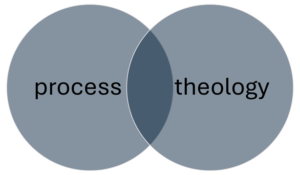
The most common and the default operator is AND. When you type a multi-word phrase into the search bar, like process theology, the system reads process AND theology. It will search for any record that contains both the words process and theology anywhere in the record, but it will not make a difference if or how those words are used together. So a book titled Process Theology as Political Theology shows up in the same list of results as a book called Intercultural Theology with the generic word “process” somewhere in the description.
That doesn’t mean this most basic method of searching doesn’t work. Since “process theology” is a technical term and there are a lot of books and papers in the DTL about it, if you just search for the phrase process theology you’ll find a lot of helpful materials. In fact, if you just type process, you might get the journal Process Studies in the first page of results. You also get a lot of irrelevant stuff, though, so if you find yourself wading through a lot of unhelpful results, you may need to redesign the way you’re phrasing your search.
Adding more words will naturally narrow down your search. If there are 10,000 records with both process and theology somewhere in them, adding philosophy will eliminate any of those 10,000 without that third word. The more words you add to a basic search like this, the more targeted and therefore more limited it will be. Most of the time you can find a specific book or article simply by typing in the author’s last name and two or three important words from the title. Go to the DTL and search for the phrase rogers god graffiti. You should get CST Professor Frank Rogers’s book Finding God in the Graffiti as the first or second result.
- Tip: Sometimes as you’re typing the system will give you a dropdown list of potential search terms. You can select one of those terms if it matches what you’re looking for, or you can ignore the list and do it on your own. If you decide to ignore the dropdown list, you may need to manually click the search button on the right side of the search bar, because sometimes the top item in the dropdown list will automatically select, so if you just hit the return key to search it will search for that instead of what you typed. Every computer system has its minor annoying features, and this is one of the DTL catalog’s.
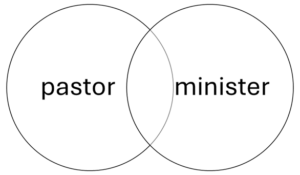
A useful way to change up your search phrasing is the operator OR. This operator is most helpful when you’re working with synonyms. The search process OR theology will find every record with the word process and every record with the word theology, including records with both of them. That’s probably way too much, and most of them will be unrelated. But maybe you’re looking for materials on Protestant religious professionals. You can type pastor OR minister to get a wider range of results than if you just searched for one of the words by itself. This phrasing accounts for the fact that there are multiple and sometimes interchangeable ways to refer to someone who leads a Protestant church, and you can’t be sure which one a useful book or article might use.
Since OR is likely to find much larger numbers of results than AND, it’s best to use it carefully or in combination with other operators.
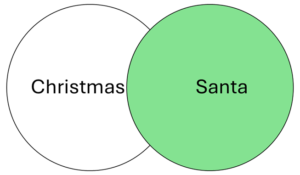
This is the most challenging operator, because it’s easy to accidentally eliminate things you might want to see. It’s best to use NOT when you’re searching for a term that has uses in multiple very different contexts or if you want to eliminate items on an obscure subtopic.
Let’s say you want to do research on Christmas, but you aren’t interested in materials about Santa Claus. You can search for Christmas NOT Santa, (the section below on quotation marks will explain how to get the whole name Santa Claus into this search), but that might mean you don’t see records for books that would mostly be useful but happen to have an easily skippable chapter on Santa Claus. This might not be a good time to use NOT.
However, NOT can be useful in other cases. Maybe you type Christmas into the catalog and get millions of results, but for some reason a lot of the top results are materials about the plant sometimes called the Christmas cactus. In this case you can try Christmas NOT cactus or Christmas NOT botany or something similar to eliminate those irrelevant results. The DTL has access to a lot of medical journals because they come bundled with some other subscriptions, so you may find yourself in situations when adding NOT medicine or similar can help declutter your results.
You can also use NOT to keep more obscure subtopics out of your results. Santa Claus is a highly integrated feature of Christmas in the United States, so using NOT to avoid materials about Santa might backfire. However, the European figure Krampus has only recently gained a lot of visibility in the US, so if you’re not interested in German and Austrian celebrations of Christmas, maybe the phrase Christmas NOT Krampus will help you narrow your search down.
- Tip: It is usually more effective to add an AND to your search rather than a NOT. Alexandria AND Egypt will get you more relevant results than Alexandria NOT Virginia, both because it positively identifies your target, and because you won’t accidentally eliminate books about the Egyptian city that happened to be written by scholars named Virginia.
- Tip: NOT phrases are order dependent, meaning Christmas NOT Santa is a different search from Santa NOT Christmas. See the section below on parentheses for more about syntax and order in search strings.